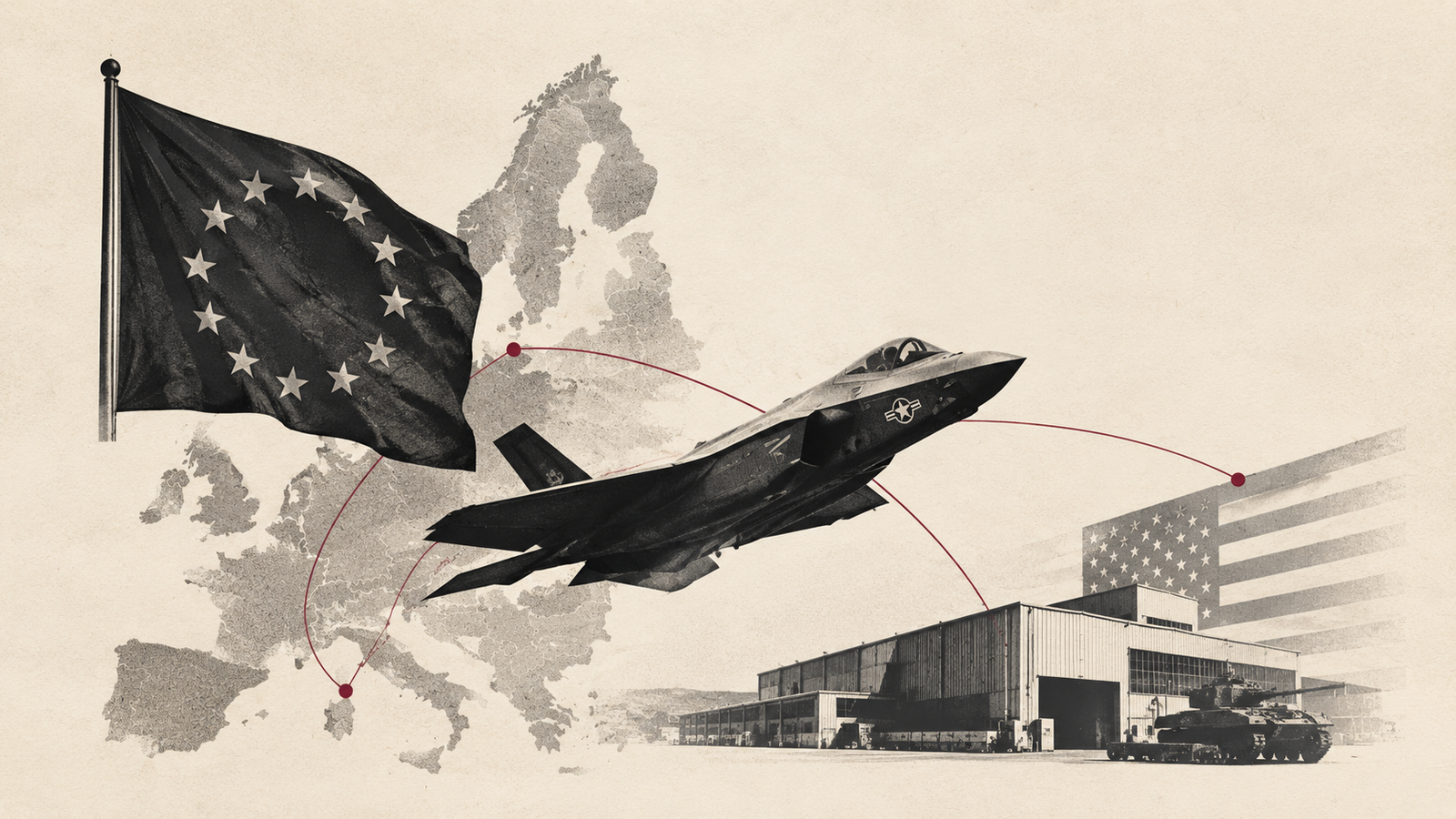
For most of the post-Cold War period, European defense spending was an afterthought. A large war on the continent seemed implausible, and governments redirected money toward other priorities for three decades. That assumption broke in February 2022, when Russia invaded Ukraine.
A second shock followed more recently. Donald Trump’s return to the White House brought open pressure on European governments to spend far more on their own defense, along with repeated, unresolved doubts about how firmly the United States stands behind NATO’s security guarantees.
These factors have combined to produce the current European rearmament cycle, and with it comes a question: Whose industry actually benefits?
The answer is complicated. The debate mixes together three different things:
The real money European governments spend each year
The political program the European Commission has branded “ReArm Europe”, and later “Readiness 2030”
And the specific financial instruments built to deliver it
Three things being sold as one
In March 2025, the Commission unveiled a package initially called “ReArm Europe” and later renamed “Readiness 2030”. It isn’t a pool of new EU money waiting to be distributed, but a framework that makes it easier and cheaper for member states to spend more on their own.
It combines three elements:
National fiscal flexibility lets countries temporarily exceed EU deficit limits if the extra spending goes to defense. A mechanism the Commission says could theoretically free up roughly €650 billion over four years across all member states.
SAFE (Security Action for Europe) is a €150 billion facility of long-maturity loans the Commission borrows on capital markets and lends on to member states at favorable rates, specifically to fund joint procurement.
And there is a smaller, more open-ended pool from the European Investment Bank and a proposed "savings and investment union" meant to mobilize private capital.
Add it up and the Commission talks about mobilizing “up to €800 billion.” That figure has generated most of the headlines. It is a theoretical ceiling on what member states could borrow and spend, not money that has been committed or disbursed.
Bruegel, the Brussels-based economics think tank, has noted that most of that total depends on individual governments actually choosing to take on more debt - a decision each country still makes for itself, and one several are in no hurry to make.
What EU governments are actually spending
Set the political branding aside and look at what the European Defence Agency (EDA) the body that tracks this every year, actually reports. According to its 2026 data, EU member states spent €418 billion on defense in 2025, up 20% from the year before, and are projected to spend €454 billion in 2026, taking average spending to roughly 2.4% of EU GDP, up from 2.2% in 2025.
Of the 2025 total, about €115 billion went to equipment (weapons, vehicles, systems) and roughly €17 billion to military research and development, a figure the EDA projects will rise to around €20 billion in 2026.
One number stands out more than the headline totals: only about 24% of equipment procurement in 2026 is projected to be done jointly between two or more countries. The rest is still spent by individual governments buying alone. That detail matters more than it looks, because it is the thread connecting almost everything else in this debate.
Separately, NATO set its own target at the Hague summit in June 2025: allies committed to reach 5% of GDP in security-related spending by 2035, split between 3.5% on core military spending and 1.5% on a broader category covering critical infrastructure, cybersecurity and resilience. It is a ten-year horizon, not a near-term benchmark, but it signals the direction Washington has been pushing its allies to move in.
Where the new money has been going
This is where the more uncomfortable numbers appear. When a European government "spends more on defense," it does not automatically buy from a European company. It might buy an F-35 fighter jet or HIMARS rocket launcher from Lockheed Martin, a Patriot air-defense system from RTX, or Javelin missiles the two firms produce jointly - all American suppliers.
Bruegel's research on Foreign Military Sales (FMS) - the US government mechanism that approves and manages sales of American weapons abroad - puts a number on this shift: between 2022 and 2024, 50.7% of equipment purchases notified by European NATO members went through FMS, up sharply from 27.8% in 2019-2021. In 2024 alone, FMS notifications to Europe reached roughly $76 billion, about four times the historical average. The distribution across countries varies widely: Poland accounted for close to 30% of all European FMS purchases, while Germany routed a much smaller share, under 20%, of its purchases through FMS, leaning more heavily on domestic and European suppliers.
Analysts point to three overlapping reasons.
First, there are real capability gaps: Europe does not currently produce an equivalent to a fifth-generation fighter like the F-35, or to certain long-range missile systems.
Second, urgency: governments that suddenly needed to rearm bought what was already in production rather than waiting years for a European alternative to mature.
Third, a geopolitical calculation: buying American hardware was, for some governments, also a way of purchasing continued US commitment to European security.
That logic has a long tail. Systems like the F-35 depend on software and logistics infrastructure controlled from the United States, which gives Washington some ongoing influence over how those systems are used and maintained, even if the existence of a literal remote "kill switch" remains debated and has not been publicly confirmed.
Financial markets tell a more layered story than a simple winners-and-losers split.
Over the twelve months to mid-September 2026, the index tracking US defense contractors (ITA) rose about 10.5%, while its European counterpart (EUAD) was roughly flat to slightly down. But this comparison flatters the US side because the period starts after Europe’s big rearmament rally had already peaked: EUAD returned as much as 68% in the twelve months to February 2026, before European defense stocks consolidated through the spring. GE Aerospace, RTX and Boeing alone made up roughly 47-48% of the US index by September 2026, up from 46.33% at the June 30 close. The honest read isn't "Europe is losing the rearmament boom to American contractors" - it's that both rallied hard, and Europe's rally simply came first and cooled first.
Brussels writes itself a rulebook
The instruments built since 2025 are, in part, a direct response to that data. SAFE requires that at least 65% of the value of any weapons system it finances originate in the EU, Ukraine, or EEA/EFTA countries; the remaining 35% may come from elsewhere.
A handful of countries with a formal EU Security and Defence Partnership can qualify for the same 65% treatment as EU members. The United States is not on that list.
The European Defence Industry Programme (EDIP) sets a similar 35% ceiling on non-EU components and explicitly bars parts sourced from countries whose security interests conflict with the EU's.
Both instruments also require that European firms retain "design authority" over the systems they build - the right to modify, maintain, or export them without a third country's sign-off.
Washington has noticed. Defense-industry press, including National Defense Magazine, has described the SAFE content rules as a deliberately designed barrier meant to shrink the US industry's European market share over time.
At the same time, the Commission has approved contracts that blend European and American firms within these same rules - European missile consortium MBDA working with RTX, or Lockheed Martin partnering with Sweden's Saab - which suggests that "excluding the US" and "reducing its market share" are not quite the same policy. The content rules cap how much value can leave the EU; they do not forbid transatlantic cooperation altogether.
The counterevidence, and why the data itself is part of the story
Here the picture gets genuinely harder to pin down. Bruegel's own broader analysis - looking not at FMS notifications but at total executed defense spending - reaches a noticeably different conclusion: imported equipment, from any country, typically accounts for less than 10% of total European military spending, because most of a defense budget goes to personnel, maintenance and operations rather than new hardware, and most of that hardware spending still goes to domestic or European producers.
By this measure, neither France nor Spain looks remotely dominated by American suppliers: in France in 2022, roughly 60% of military imports came from within the EU and only about 10% from the US; in Spain in 2021, some 76% of imports were intra-EU and just 6% American.
The gap between these two readings is not simply a disagreement about politics - it reflects the fact that "FMS notifications" and "total executed spending" measure different things. A notification is an approved contract that can take years to be delivered and paid for; total spending captures money already spent on everything from ammunition to salaries.
Bruegel's own analysts have also flagged that the 2022–2024 FMS surge looks larger partly because it is measured against an artificially low 2021 baseline, the year before the invasion reset the entire spending picture. For a project built on distinguishing facts, estimates and opinion, that methodological gap is itself worth reporting: even the underlying numbers in this debate are contested, and both readings can be defensible depending on what question you are asking.
The real bottleneck may not be Washington
Put the two data sets side by side and a different framing emerges. The "dependency" story is largely a photograph of 2022-2024, the emergency phase, when European governments bought whatever was already built. The "autonomy" story describes the legal architecture assembled for 2026 and beyond, whose actual effects cannot yet be measured because the programs are too new. Neither reading is wrong; they are pictures of different moments in the same process.
But the number that deserves more attention than either narrative gives it is the 24% collaborative-procurement figure from the EDA's own data. Three-quarters of EU equipment spending is still 27 governments buying separately, each negotiating its own contracts, maintaining its own logistics chains, and in many cases buying different versions of similar equipment.
That fragmentation is not something SAFE's 65/35 rule or EDIP's design-authority requirement can fix directly. Those instruments cap how much value leaves the EU, but they don't by themselves make Poland and Germany buy the same tank.
A European industry with 27 separate national customers, none individually large enough to fund a fifth-generation fighter program alone, will struggle to compete with US primes regardless of what content rules say on paper. Once a European army has invested in the F-35 or the Patriot system, the switching costs - spare parts, munitions, software updates, training - lock it in for decades, making any future change of supplier progressively more expensive the longer the current pattern holds.
What to actually watch
The question of whether Europe's rearmament serves European industry cannot be answered yet, because the instruments meant to answer it are barely a year old, and defense contracts are typically signed years before delivery.
What can be tracked is more specific: whether the 24% collaborative-procurement share rises meaningfully over the next two to three years, whether SAFE-financed contracts actually hit their 65% European-content threshold in practice rather than on paper, and whether countries like Poland begin directing new contracts toward SAFE-eligible joint programs.
The more useful question for European policymakers may not be "how do we compete with American contractors," but "why have 27 armies spent three decades unable to buy together." SAFE and EDIP are the first serious institutional attempt to force that coordination. Whether they work will say less about transatlantic rivalry than about whether the EU can solve a problem that predates Vladimir Putin, Donald Trump, and the current rearmament cycle by many years.
Notes
- European Defence Agency — EU defence spending: €418 billion in 2025, projected to €454 billion in 2026 ↩↗
- Consilium — What is Security Action for Europe (SAFE)? ↩↗
- Consilium — SAFE: Council adopts €150 billion boost for joint procurement on European security and defence ↩↗
- Consilium — European Defence Industry Programme: Council gives final approval ↩↗
- NATO — The Hague Summit Declaration ↩↗
- NATO — Defence investment and NATO's 5% commitment ↩↗
- Bruegel — Europe's dependence on US foreign military sales and what to do about it ↩↗
- Bruegel — What role do imports play in European defence? ↩↗
- National Defense Magazine — Viewpoint: EU's SAFE Program Comes with Potential Pitfalls for U.S. Contractors ↩↗
- iShares U.S. Aerospace & Defense ETF (ITA) Fact Sheet, June 30, 2026 ↩
- iShares U.S. Aerospace & Defense ETF ↩↗
- iShares U.S. Aerospace & Defense ETF (ITA) ↩↗
- Select STOXX Europe Aerospace & Defense ETF (EUAD) ↩↗
- Markets European defense stocks are cooling off after the military spending boom. Here’s what’s next ↩↗